
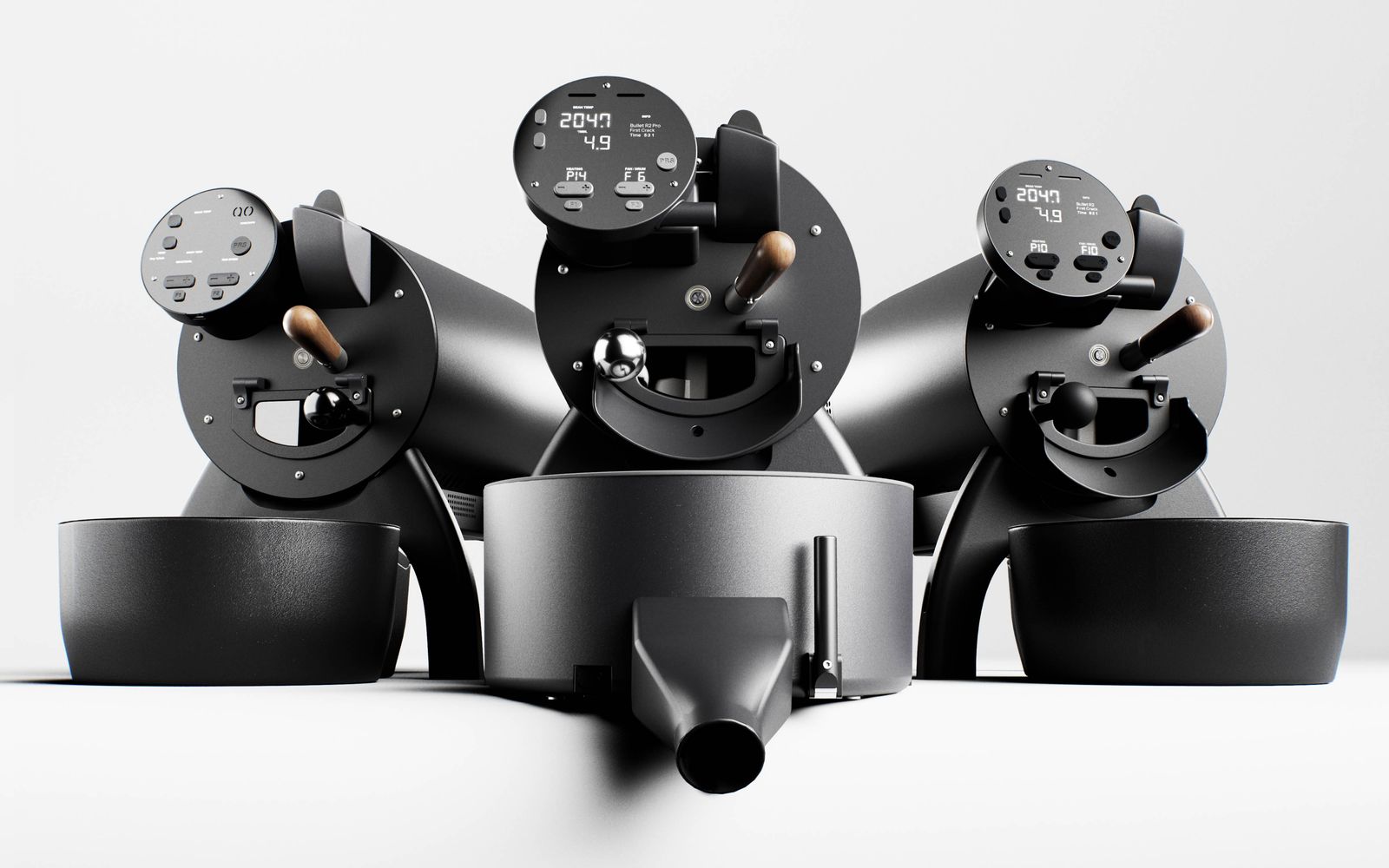
Aillio Bullet Engineering Milestones (2012–2026)
Year | Milestone | What it introduced |
|---|---|---|
2012 | Prototypes | Initial proof-of-concept for a 1kg (2.2 lbs) countertop induction drum roaster. |
2015 | Original Bullet R1 | First production shipments; direct electromagnetic induction heating, infrared drum preheat sensing, and RoasTime software. |
2019 | Bullet R1 V2 | Infrared Bean Temperature Sensor (IBTS) for batch-size immunity, plus a redesigned, more stable induction board. |
2024 | Bullet R2 & Bullet R2 Pro Series | FlowSense differential air pressure sensing, internal Barometric Pressure Sensor, Integrated Bean Deflector, Pro Cooling Tray, and upgraded induction modules with much more power and ±0.5% power delivery precision. |
2026 | Bullet R1 Retirement | Original R1 / R1 V2 platform retires after a decade of continuous production; ongoing spare parts, support, and RoasTime / Roast.World compatibility continue. |
Learning from a Decade of Roasting Data
The Aillio Bullet R1 launched in 2015, and we only stopped production of it in 2026.
In an era where modern hardware is practically engineered for obsolescence within a few years, ten years of continuous production is an eternity. While we no longer manufacture the original Bullet R1 or R1 V2, we have zero intention of leaving our early community behind. We still stock spare parts, our support desk still answers your tickets, and our software team continues pushing regular RoasTime and firmware updates to keep things humming along.
Which means even the very first preorder machines are still happily churning beans in garages, in cafes, and in coffee labs worldwide.
But we have never stopped improving upon our original design, consistently folding in new technologies based on user feedback and our own sense of how best to make coffee roasting easier for everyone: more power, fewer variables, better data, and smarter workflows.
You can see the cumulative results of a decade of real-world roasting data in our current second-generation lineup: the Bullet R2 and the Bullet R2 Pro.
From across the room, they share the same iconic silhouette that started it all. But beneath the surface, almost everything has changed.
To understand the hows and whys, we have to begin… at the beginning.
From Prototype to Launch: Enter the Bullet
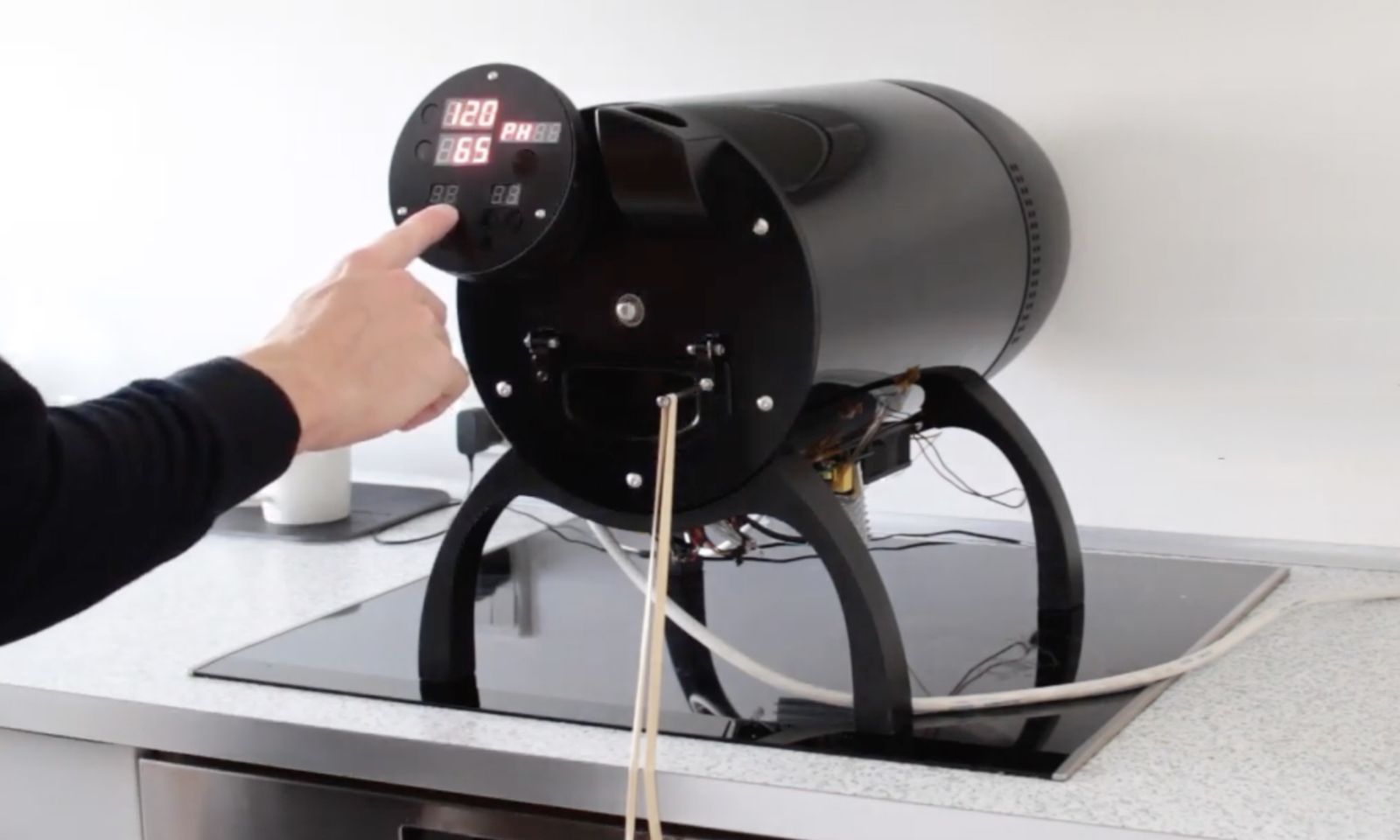
Co-founder and CEO Jonas Lillie first began playing with the concept of a new coffee roaster way back in 2012. He spread the word on popular online roasting forums, sharing his plans for a truly unique 1kg (2.2 lbs) capacity machine that could fit on a countertop and deliver better control over roasts than anything else on the market.
As he continued tinkering with prototypes in his cramped little studio apartment, his ideas were met with extreme skepticism. Some even called him a liar.
Count his brother, Jacob Lillie, among those skeptics. But once Jonas was finally able to sell him on the idea, his twin was all-in. Jacob brought the software and electrical engineering expertise that Jonas needed to realize his mechanical designs. And thus Aillio, the roaster manufacturer, was born.
Still, it was 2015 before the very first Bullets shipped out to 200+ eager preorder customers around the world. No lies: they had to wait a long time for their Bullet. We were absolutely behind schedule at launch, and remain grateful for their patience to this day.
We just needed time to get everything right.
How Does Induction Heating Work in a Coffee Roaster?
Rather than relying on gas, which is fraught with setup, space, and safety concerns, or opting for electrical resistive coils, which produce a limited amount of heat, are slow to respond to changes mid-roast, and waste a lot of energy, the Bullet offered a new approach to turning green coffee brown: induction heating.
“When we set out to engineer the Bullet, we were told that electric roasters couldn’t match the power or agility of a gas flame. We proved that direct induction heating was the answer for greater power and control without burning gas indoors.”
Unlike other means of generating heat with electricity, induction heating lacks a traditional "heating element" for the drum. Instead, the heat is created directly in the drum via the properties of electromagnetism, so that the drum itself is the heating element.
It works much the same as induction stovetops that rapidly build heat in the pan while remaining cool to the touch. Because there is so little energy wasted, induction makes it possible to safely generate a great amount of heat very quickly in a small machine, while allowing coffee chefs to make precise, responsive adjustments mid-roast.
With induction, electric roasters could enjoy the speed and responsiveness of gas while sidestepping the headaches that using gas causes.
Here's a video of Jonas himself explaining the benefits of induction in his own words. (Don't worry, you don't need to understand the technical details in order to roast fantastic coffee!)
Why Induction Heating Makes Sense for Coffee Roasting
Jonas gets geeky explaining why we heat the Bullet with induction and how it works.
 Aillio on YouTube
The Invention of the IBTS: A Better Way to Measure Bean Temperature
The feedback from our early adopters was immediate and overwhelmingly positive. For the first time, roasters were able to comfortably roast a full kilogram of greens on a machine that could fit almost anywhere within reach of a standard electrical socket, all while enjoying reliably consistent results and useful data, thanks to Jacob's RoasTime profiling software.
But we kept looking for ways to improve.
The original Bullet R1 featured another innovation that was a first of its kind: the use of infrared temperature sensing to lock in the precise drum preheat temperatures before charge, ensuring greater consistency from batch-to-batch and making it easy to answer questions like: "What happens to this coffee if I increase the charge temperature by 5 degrees?"
The follow-up question seems obvious in retrospect: If we can measure preheat temperature more precisely with infrared, can we do the same with beans?
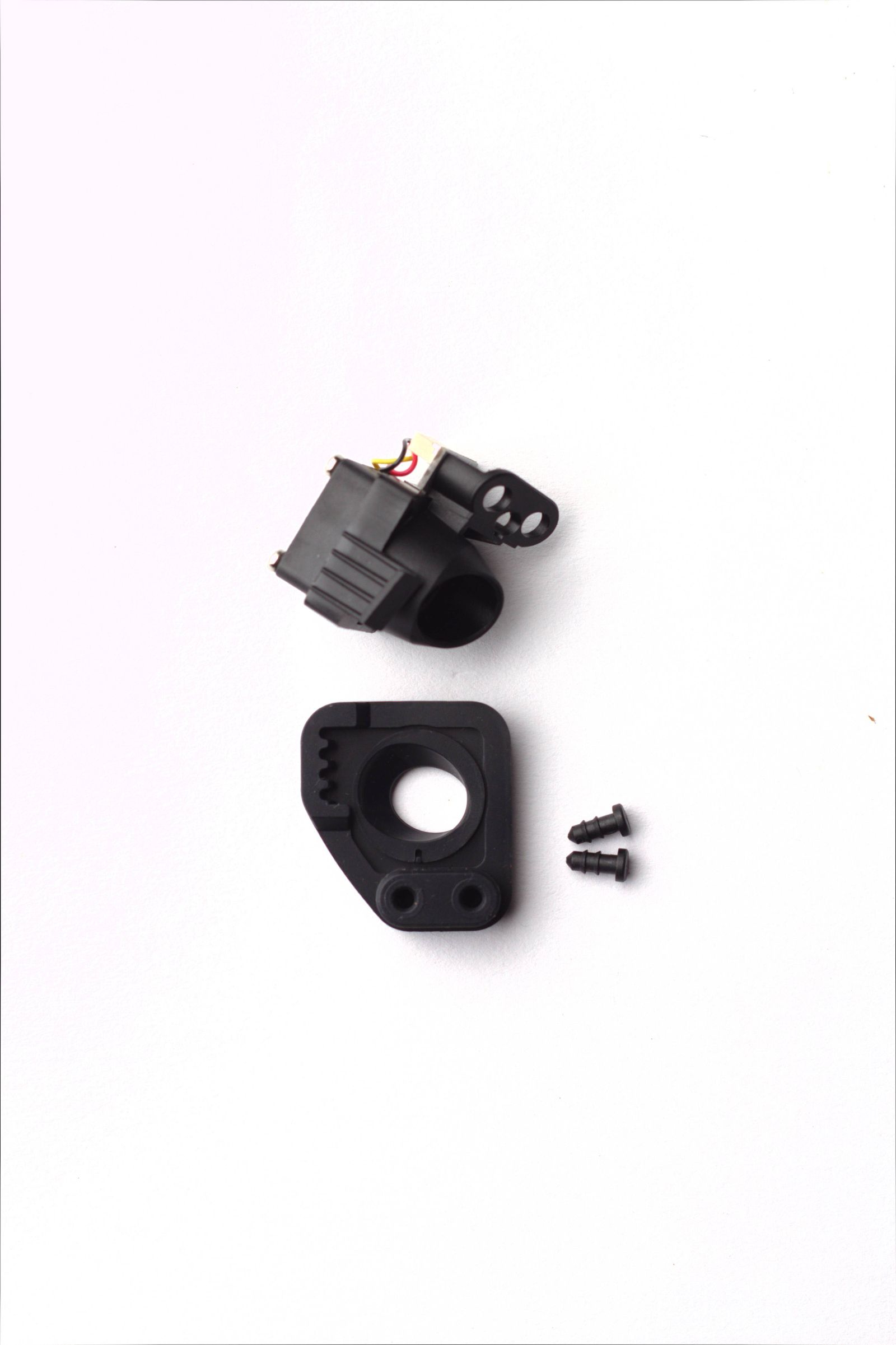
The answer is yes, though it requires a little engineering finesse to pull off. Specifically, we had to develop a special housing with a little fan, in order to keep the sensor clean while working deep in the "coal mines" of the smoky inner drum.
The introduction of the infrared bean temperature sensor (IBTS) was the first major upgrade to the R1 series. We named this new version of the Bullet the Bullet R1 V2.
Just as induction heating introduced a new way to heat beans, the IBTS introduced a brand new way to measure the temperature of those beans.
How Bean Temperature is Measured in Other Roasters
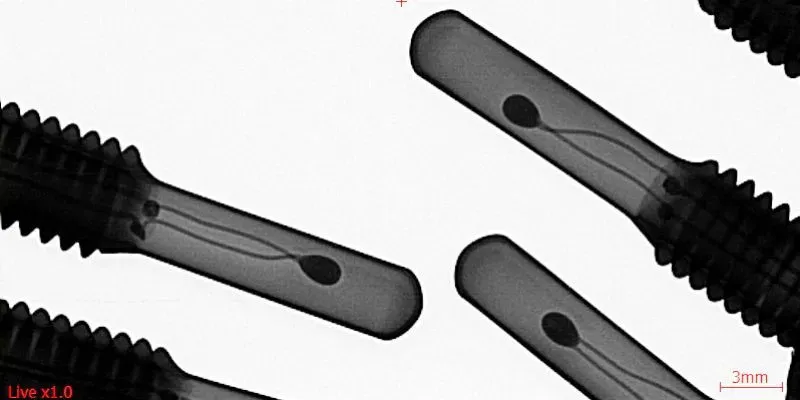
Coffee roasters traditionally rely on temperature probes that are positioned in the drum to make contact with the rotating bean mass as it roasts. Before the beans are charged, however, the roaster needs to preheat, which of course heats the probe up. When room temperature coffee comes in contact with the probe, its temperature then drops. Later on in the roast, during the turning point, the temperature of beans exceeds the temperature of the probe, which now begins to heat up as the hot beans make contact with it. This is what creates the swooping dip and rebound profile curve that so many roasters are familiar with.
But what you're seeing on a traditional roast profile is not the temperature of the beans, but rather the temperature of the probe itself. In this way, temperature probes tell lies about your coffee – sometimes big ones.
Allow us to illustrate.
The IBTS Advantage: Batch-Size Immunity
Same Beans, 300g vs. 1kg (2.2 lbs)
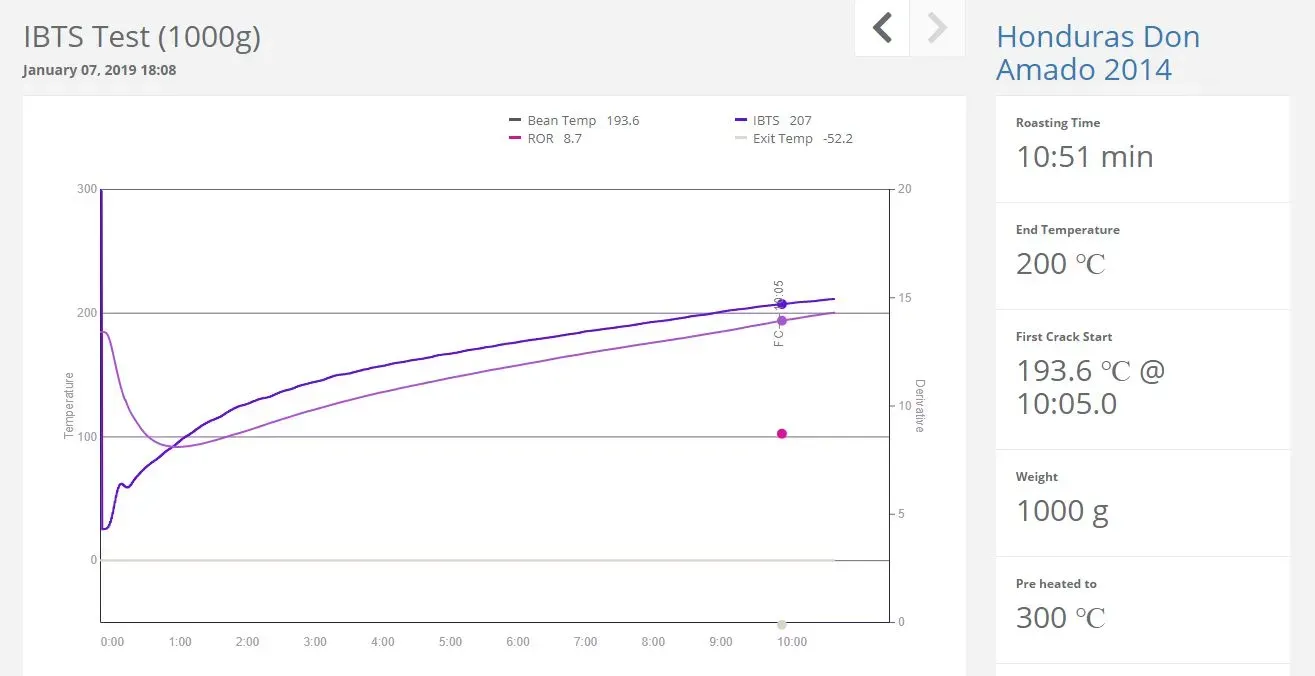
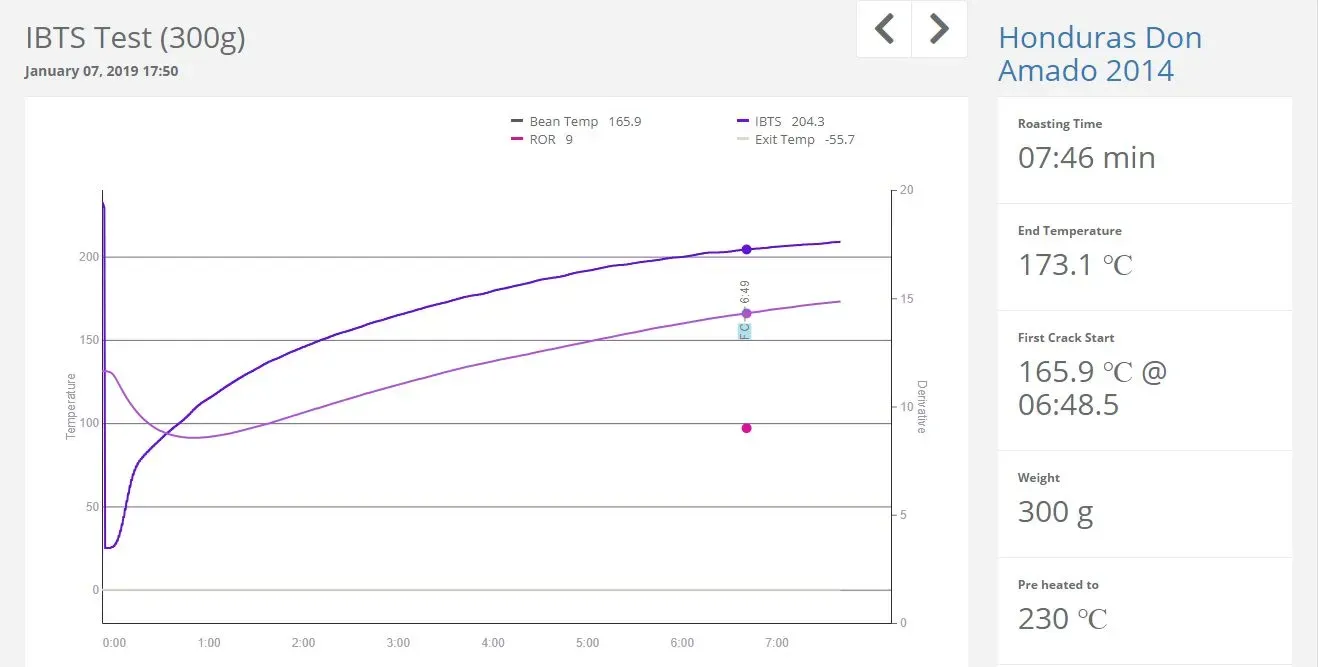
Above we can see the roast profiles we first used to demonstrate the IBTS advantage over traditional bean probes, way back in 2019. These two profiles both use the same old crop of testing beans from Honduras, in the same Bullet R1 machine, in the same office environment. The only difference is the batch size (300g vs 1000g).
On each profile are two bean curves. The dipping curve is from the traditional bean probe, the other is the IBTS. You can see that on the traditional bean probe, the first crack temperature drifts from 193.6°C on the full kilo batch down to 165.9°C on the 300g batch. That's a full 27.7 degrees of difference.
To be clear: these beans aren't cracking at different temperatures, the difference is the result of bad data from traditional bean probes.
Meanwhile, the IBTS curves on each roast both start near room temperature (the actual surface bean temp), and both reach first crack at nearly the exact same temperature, just above 200°C.
In other words: Across different batch sizes, you know once you see the IBTS temp rising past 190°C, first crack is coming very soon. This is what we mean when we say the IBTS gives us "batch-size immunity."
All Bullets, including the new R2 Series, still retain the traditional bean probes as an additional data point, should roasters choose to use them. But you won't see many OG Bullet R1s without IBTS out in the wild these days, as most have already been upgraded from the R1 to the R1 V2 by their owners.
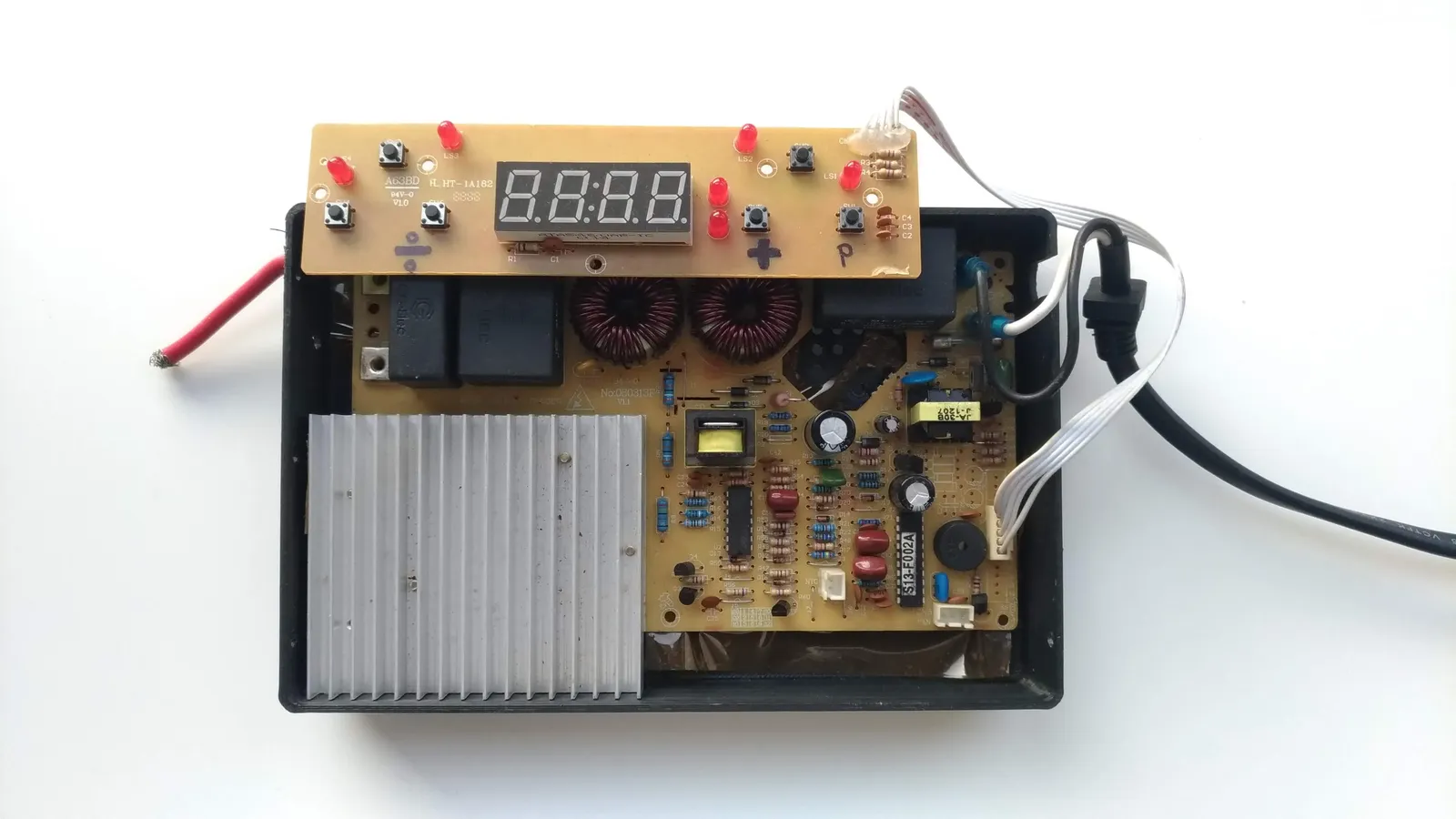
Around the time of the release of the IBTS, in addition to his duties leading the software team, Jacob Lillie had taken over electronics design for the induction board, too. He personally designed a more stable version for the R1 V2 that included better parts, and that also compensated for voltage fluctuations, which 110V units in particular were more sensitive to.
Jacob's work on improving the induction module would ultimately lead to the next step in the Bullet's evolution...
The New Generation: Enter the Bullet R2 and R2 Pro
Way back in 2012, we had set out to build the best home roaster on the market. But we couldn't imagine then that many, many of our users would start coffee businesses on the Bullet. They were roasting vast amounts of beans – sometimes even deploying multiple Bullets to meet demand.
It begged the question: What can we do to help their workflows?
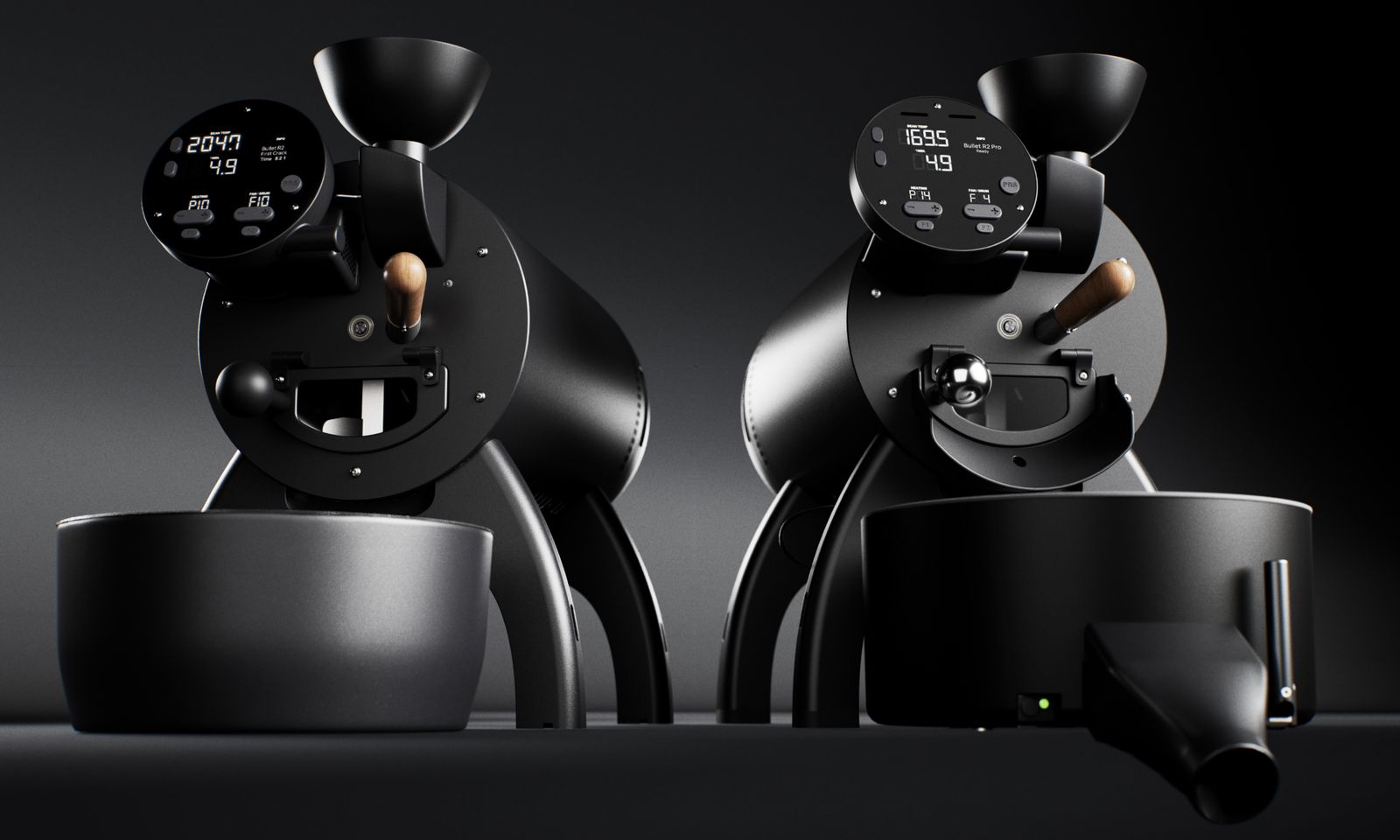
The answers arrived in our second-generation platform: the Bullet R2 and the Bullet R2 Pro.
The two units share (almost) all the same quality of life improvements.
Better Airflow Control with "FlowSense"
In the legacy Bullet R1, exhaust airflow was controlled via discrete fan steps (F1 through F9). While reliable in controlled ambient settings, air mass moving through any drum roaster is subject to the laws of fluid dynamics. And those lawas can get quite complicated!
Bullet users are, quite literally, "Roasting Everywhere"—in garages, outdoors, below sea level and on mountaintops. In addition to these environmental variables—all of which affect air density and flow in the drum—there is the physical reality of bean chaff and oil, which gradually clogs the exhaust filter and reduces airflow during back-to-back roasts even if the fan RPM is dialed in properly. Over time, this can affect batch-to-batch flavor consistency.
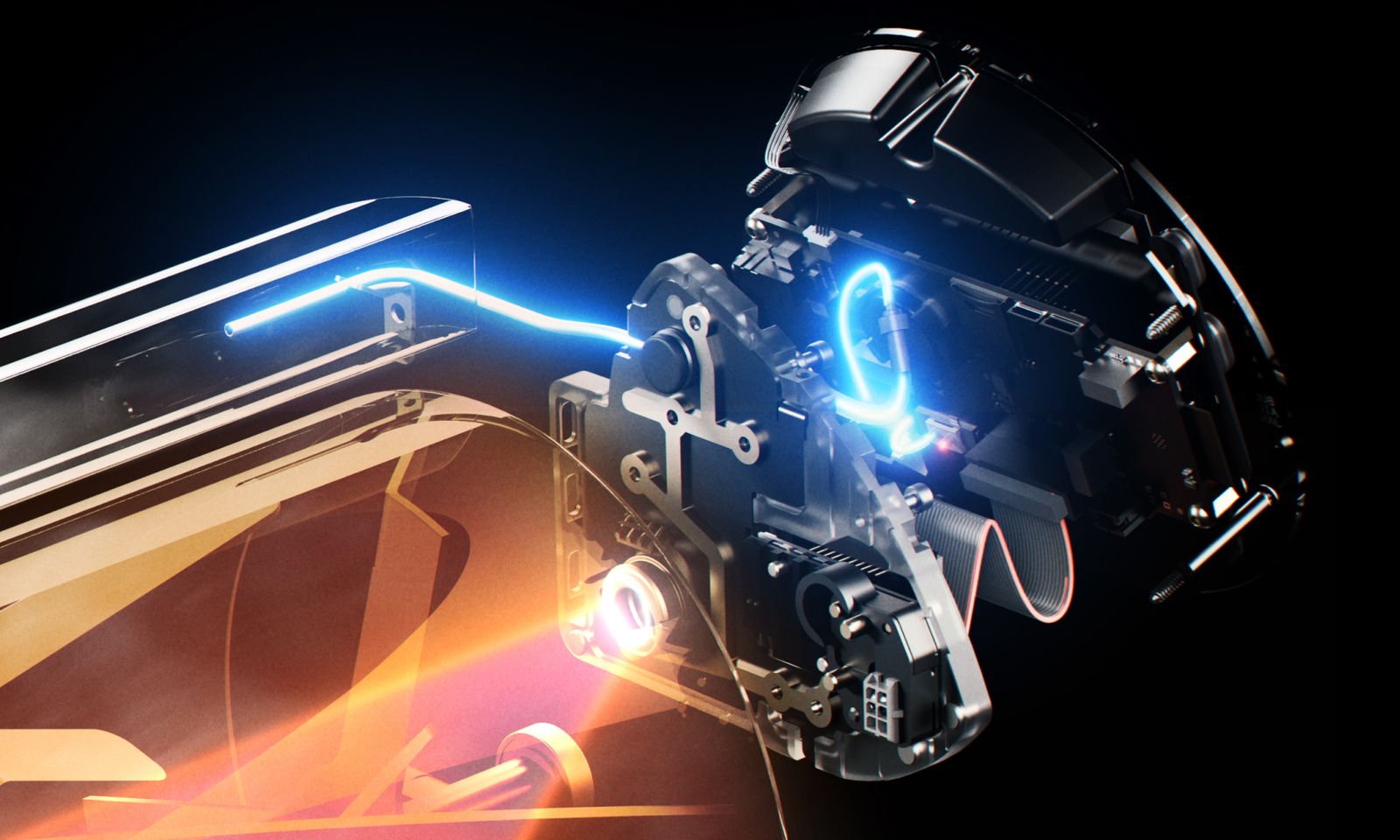
The solution is FlowSense, available in both the R2 and R2 Pro machines. Much like the IBTS gives you a more reliable read on bean surface temperature, FlowSense monitors airflow conditions inside the roaster.
Using a differential-pressure sensor in the Bullet's upper exhaust chute, FlowSense monitors changes in pressure associated with airflow conditions inside the exhaust system. When conditions change, it dynamically micro-adjusts the exhaust fan motor in real time to help maintain consistent airflow across different roasting environments.
FlowSense is a particularly useful workflow adjustment for those trying to nail down a precise roast profile with back-to-back sample roasting without cleaning the filter between each roast, or when attempting to match profiles from other users in different roasting conditions.
Additionally, both R2 models include an internal Barometric Pressure Sensor, so that whether you are roasting in Mexico City (2,240 m) or Amsterdam (sea level), the system will accommodate you!
In addition, if your Bullet is struggling to "breathe" properly, the new Filter Clean Alert will automatically let you know when it's time to clean your dirty filter! :)
Hybrid LED/OLED Control Module & Live Diagnostics
The Bullet R1’s external LED Control Panel certainly gets the job done. But the R2 series replaces it with a crisp new Hybrid LED/OLED Info Display. The new interface allows roasters to easily toggle through more information, settings, and live metrics—including the new Differential Air Pressure readings from FlowSense.
Not only is it "easy on the eyes", it feels easier to use and is a legitimate quality-of-life booster.
The Integrated Bean Deflector
In high-volume environments, workflow speed is critical. It's no secret: when it came time to drop the beans at the end of a roast, the Bullet R1 and R1 V2 were a bit… leaky. In big batches, errant beans might leap past the rim of the cooling tray, causing a small mess (and adding to clean-up time) if you didn't deploy a bean spatula to interrupt their death wish.
The R2 and R2 Pro address this with a redesigned drop chute featuring an integrated Bean Deflector, helping channel roasted coffee directly into the cooling tray to reduce spillage and cleanup.
"Spotlight" Roasting Light
The R2 Series also includes a high-intensity, color accurate LED "spotlight" for clear visibility into the drum, so that you can check the progress of your roast even in dark environments.
QuickClean: Easier Access for Maintenance
The Control Panel of the Bullet R2 and R2 Pro is now attached with magnets, making it quicker and easier to remove when necessary, for instance to wipe the IBTS when it needs cleaning.
The Pro Cooling Tray
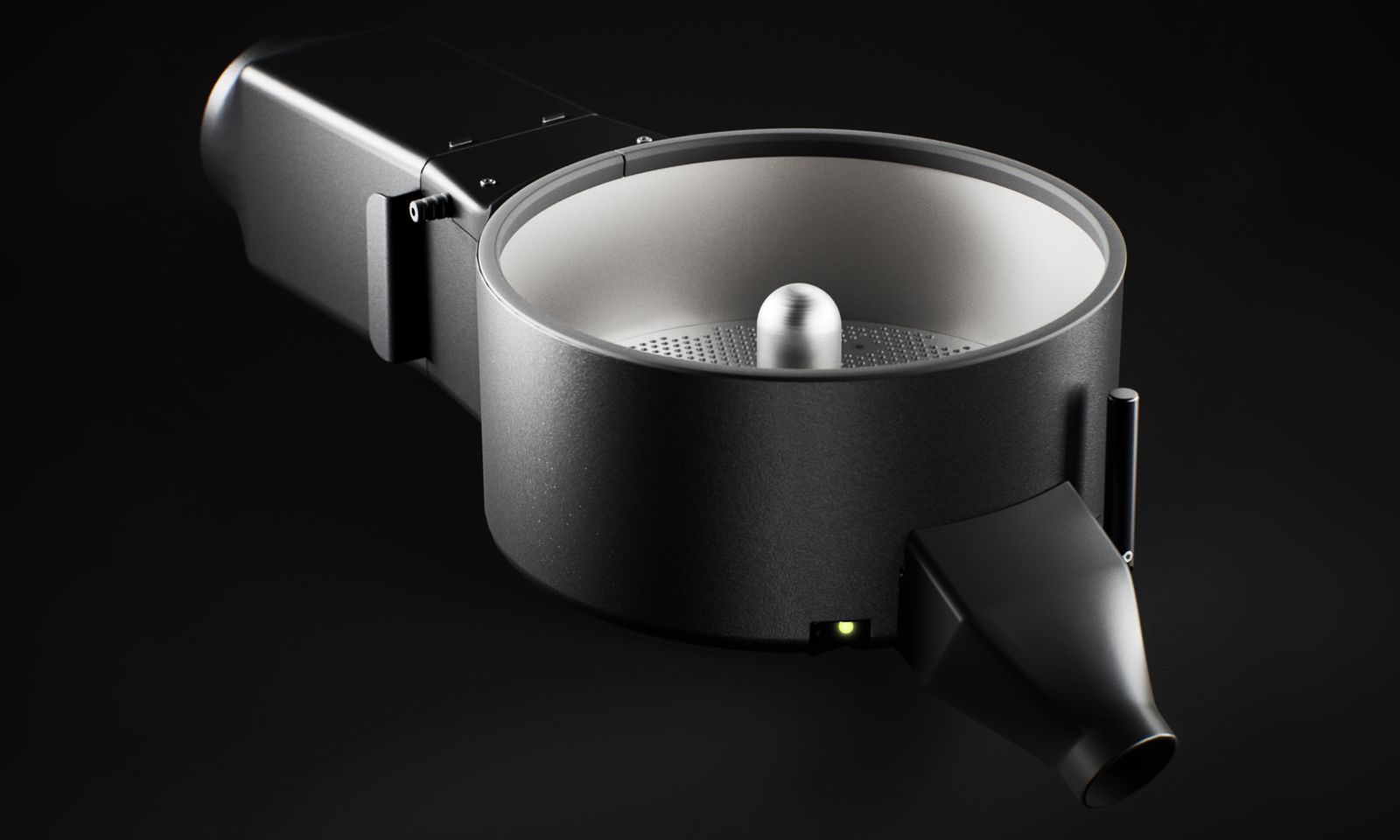
To support commercial throughput, the included Pro Cooling Tray features automated silicone stirrers and a direct-bagging chute, cooling full 1.2 kg batches quickly to help lock in volatile flavors while simplifying your roastery workflows.
And when we say quick, we mean quick.
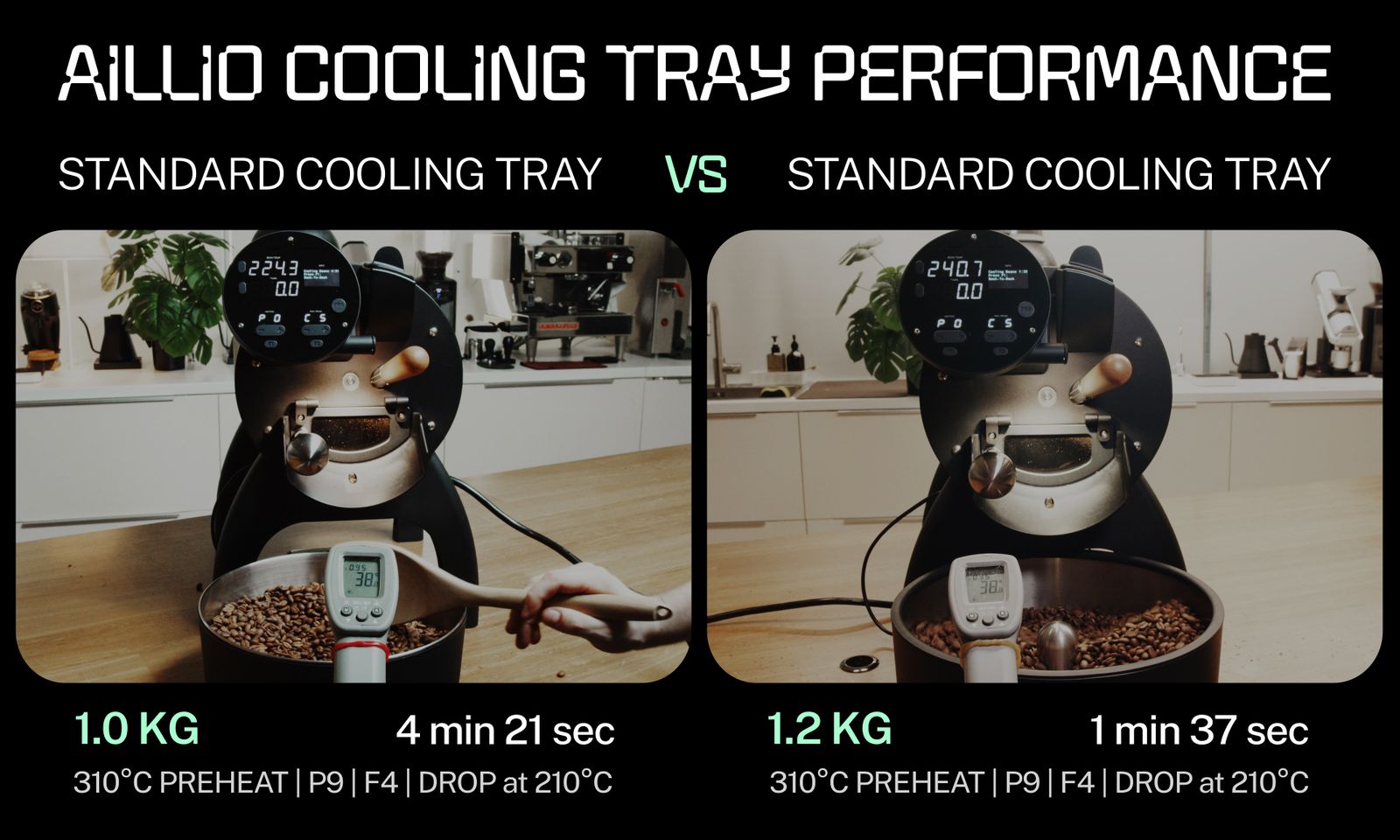
Although the Pro Cooling Tray ships for free alongside the Standard Cooling Tray with the Bullet R2 Pro, it will soon be available for purchase for R2 and even R1 owners.
The R2 Pro's 2,300W Induction Module
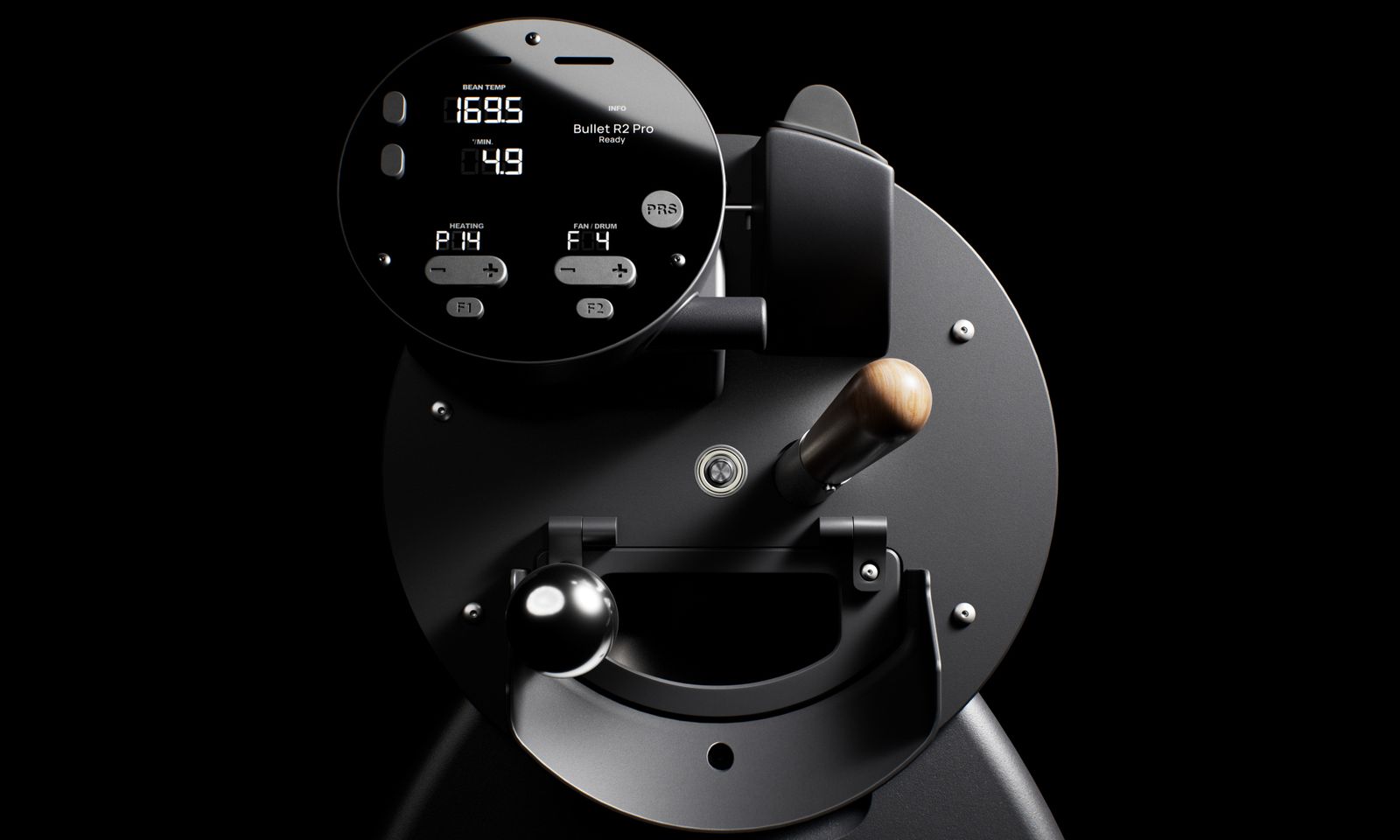
The Bullet R2 Pro is, in all ways, "peak" Bullet. Jacob engineered a brand new induction module in-house that provided a huge boost to the power, taking it from 1550 watts up to 2300 watts, representing a full 5 steps of extra induction power over the Bullet R1, which tops out at P9. The power delivery accuracy is also substantially improved from the R1's respectable ±2% all the way down to ±0.5%.
With that added power comes a 20% increased capacity of up to 1.2 kg (2.65 lbs) per batch, and the ability to drive that full-batch to first crack in under 7 minutes – all without sacrificing the small footprint of the machine.
And trust us when we say that 1.2kg capacity is true capacity. You don't need to limit the drum to 80% capacity, as is typical with other roasters.
Keep in mind, due to its 2,300W ceiling, the R2 Pro is built exclusively for dedicated 200V–240V circuits (drawing 10–12A).
The Bullet R2's 1,700W Induction Module
With 1700 watts of power, 150 watts more than the Bullet R1 V2, users enjoy an extra Power step (P10) and significantly more heating headroom while roasting, allowing for more control even with the biggest batches. It, too, features the same refined power delivery accuracy of the Pro at ±0.5%.
Crucially, the R2 remains compatible with standard 110V/120V (15A) household outlets (as well as standard 200-240V international plugs).
For roasters in 110V regions who don't need the R2 Pro's 2,300W ceiling, the Bullet R2 delivers the exact same second-generation platform on a standard household circuit with no rewiring required.
Conclusion: The Path Forward
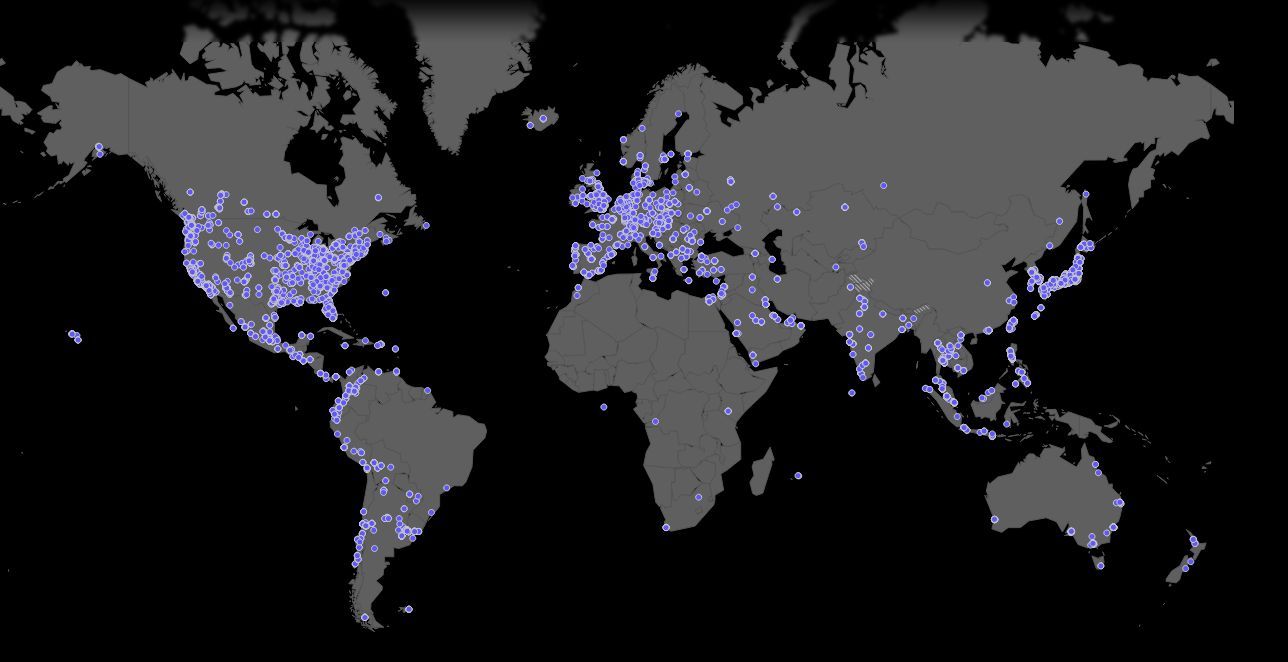
Since the first Bullet shipped in 2015, we've sold nearly 20,000 of them. You can find them all over the world in homes, cafés, and coffee labs. The R1 laid the groundwork, the R1 V2 and its IBTS changed how roasters profile their beans, and the R2 series elevates the platform with more power, better airflow sensing, and a much faster Pro Cooling Tray.
Whether you're still roasting on a well-used R1, choosing an R2 for home or small-batch work, or running a commercial operation on the R2 Pro, you're part of a community of roasters who care about the same thing: great coffee.