
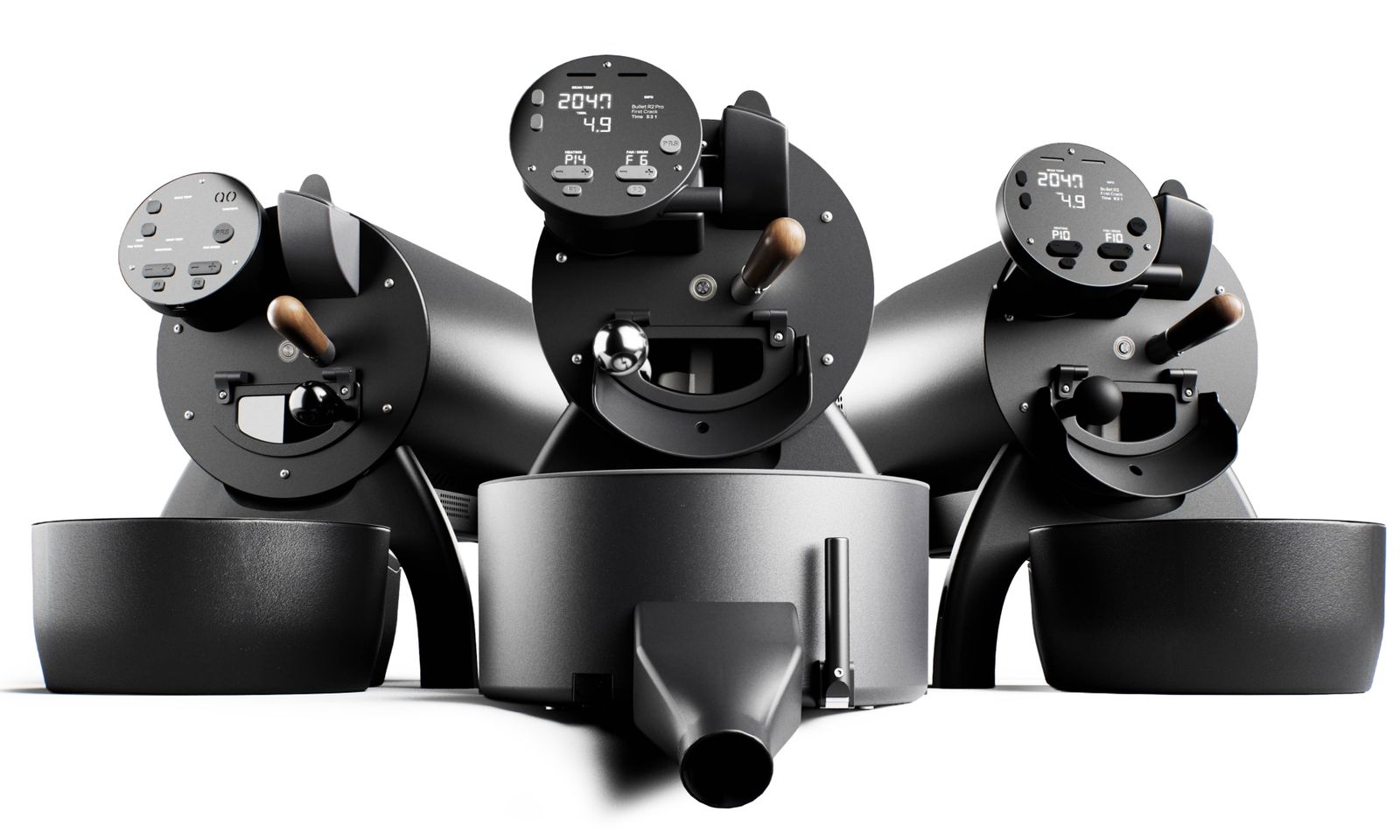
The hardware milestones and hard-won lessons behind every generation: why we use induction, why we measure bean temp differently, and how we make airflow easier to manage.
01
How has the Aillio Bullet evolved since 2015?
Over the last decade, alongside innumerable minor improvements, we’ve upgraded the original Bullet in four major ways: Better temperature data: Adding an Infrared Bean Temperature Sensor (IBTS) alongside the traditional bean probe for faster, more accurate surface-temperature readings. Adaptive airflow: Moving from fixed fan steps to FlowSense, which adjusts fan operation on the fly to help keep airflow consistent in different environments. More power, tighter control: Scaling induction output up to 2,300W on the Bullet R2 Pro, while tightening power delivery precision to ±0.5% across R2 Series models. Faster, cleaner cooling: Introducing the Pro Cooling Tray on the R2 Pro, featuring automated stirrers and a bagging chute for smoother commercial workflows.
02
Why does an infrared sensor (IBTS) read differently than a traditional bean probe?
Traditional bean probes rely on physical contact with the bean mass, which introduces thermal lag—especially on smaller batches. Because the IBTS reads the surface temperature of the beans directly, it avoids that contact lag. In our 2019 comparison tests, the traditional bean probe recorded first crack at 193.6°C for the 1kg batch and 165.9°C for the 300g batch, a difference of 27.7°C (50°F). The IBTS readings were nearly identical between the two roasts, illustrating the concept of "batch size immunity."
03
How does FlowSense keep roasting airflow more consistent?
Fixed fan-speed settings don't guarantee consistent airflow in the drum, because chaff buildup, venting setups, and even altitude all affect how much air moves through the roaster. FlowSense uses a differential air pressure sensor in the exhaust system to monitor airflow conditions and automatically adjusts fan RPM to help keep airflow consistent from batch to batch.